
AI is changing how organizations get work done
The shift is structural — AI is not just one or three new tools. The transformation lies in redesigning work itself.
I've been working on this since my time at IBM: Diane Gherson, IBM's former CHRO, launched this process in 2014, and I was part of her HR team in shaping and implementing this AI-driven workforce evolution.
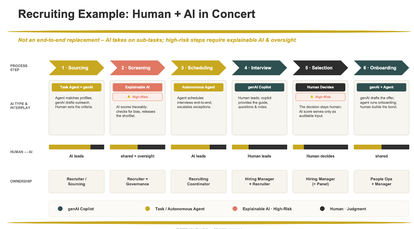
- A blended workforce is already reality: people and AI have long been working together — but usually without structures to steer it.
- The missing layer: work architecture as the connection between people, AI, and work (= tasks and subtasks).
- From job architecture to work architecture: AI acts at the level of tasks and subtasks — not entire roles.
- By 2030, around 75% of roles will need a redesign, upskilling, or redeployment (MIT/McKinsey 2026, Microsoft Work Trend Index 2026).
My expertise for your success
I help you to identify high-impact workflows so you can take the first steps toward a "blended workforce" — in a business-oriented and measurable way.
In the first step, I work with the tools you already have: standard, on-board means are enough to get an initial sense of what works. After a first trial run, you know whether — and which — additional technology can deliver which type of value.
My network of European and global providers of AI, governance, and security technology, along with partners for complex process design, supports this as needed. Empathy mapping and design thinking offer an effective method for quickly and iteratively testing, learning, improving, scaling, and measuring: precise, pragmatic, provable.